Showing posts with label Alternative energy. Show all posts

Friday, July 28, 2017

New Batteries are on the horizon!
Technology has so changed and is advancing at a rapid pace, but we're still attached to aged battery technology. The now common-place lithium-ion batteries have obvious limitations and big technology companies are investing into battery development. Check out some new ideas in energy for our devices:
Lithium-air breathing batteries
Lithium-air means using oxygen as the oxidiser, rather than a material. The result is batteries that can be a fifth of the price and a fifth as light as lithium-ion, plus they could make phones and cars last five times longer.
The new discovering was made at Dallas University and should help push developments in lithium-air forward. Of course, like a all research, this could still be five to ten years away from becoming a reality.
More at: http://www.pocket-lint.com/news/130380-future-batteries-coming-soon-charge-in-seconds-last-months-and-power-over-the-air

Monday, May 29, 2017

“How much will it cost to power my XX,XXX square foot house?”
“How many solar panels do I need to eliminate my electric bill?”

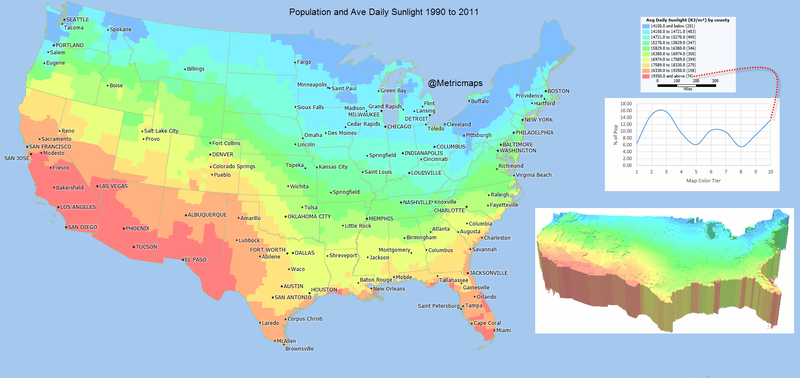
These are the type of questions people will ask when they are contemplating installing a Solar system. Of course there are many things to consider when designing a system for your own home. Once you have looked over your wattage use from information provided in a previous post you can begin to think about your solar panels. First of all, where do you live? Your ability to use the sun for power will depend on high much sun you get annually. You can look at a chart which describes the amount of sunlight that you will get depending on the area of the country or world that you live. Here is a chart for the United States.

Another thing you will need to consider is the angle of the sun where you live and how your roof is configured. Most solar panels are mounted on the roof although you don't have to put them there. It's more expensive to mount the panels on a separate frame but this facilitates the ability to adjust the panels according to the sun's path, providing power for a longer period of time.

So as the planning continues for a home solar array you will start with these ideas first.
1. Calculate your home wattage use
2. Learn about the sunlight hours in your local area and how the sun tracks through the sky
3. See how your home or yard area can be used to capture sunlight for maximum power input

Once you have considered these questions it will be time to start figuring the type and amount of panels you will need to provide additional power for your home.

Saturday, May 27, 2017

Get started with home Solar!

When you decide you want to put a solar system on your home there are some things to consider before you get started. You'll want to find the right place to install the solar panels so you get maximum exposure to the sun, you'll need to assess your power needs to understand the amount of panels to use and the battery storage requirements. The first thing you should do is to use a checklist and find out what your power usage is on a monthly basis. Each of your appliances will use a certain amount of power and depending on what your lifestyle is, you'll learn what unit is using the most power and how to assess your overall power needs. The following chart will give you an idea of some standard wattage usages. These are some wattage ratings for typical household appliances and home electrical devices. Check the rating on your personal items for an accurate wattage count.

Light Bulbs - 60 / 70 Watt60/70
Dishwasher1500
Refrigerator / Freezer700*
Microwave1000
Coffee Maker1000
Electric Range1200
Radio / Television50 - 500
Security System500
Computer w/17" Monitor800
¼ HP Garage Door875
Clothes Dryer5000
Washing Machine1500
Toaster Oven1500
Hot Water Heater5,000
Blender300
Stereo300-450
Ceiling Fan100
Floor Lamp100
Hair Dryer600-1200
Window Unit750-1200
Hedge Trimmer450
Lawn Mower1200
Weed Trimmer500
Edge Trimmer500
Furnace Fan Blower - ⅓ HP700*
Window AC - 12,000 BTU3250*
Central AC - 10,000 BTU1500*
Central AC - 24,000 BTU3800*
Heat Pump4700


Next you would calculate the Watt Hour which would be the Wattage rating times the hours used. Load Calculation Example:Lets say you want to run a 11W compact fluorescent lamp (CFL) for 5 hours from a solar panel, then the watt hour is equal to:
Watt Hour = 11Watts x 5 hr = 55 Watts
Once you have calculated your total monthly wattage use you can get an idea of what size of solar array to install in your home. This is the first step you need to take in order to properly plan your home solar installation. Stay tuned for the next step

Friday, April 21, 2017

No One Saw Tesla's Solar Roof Coming


Elon Musk is a true visionary with his dreams of Electric Cars, space exploration and now Solar Roofs that are indistinguishable from ordinary roofs. In this article from Bloomberg news we see roof shingles made of textured glass that allow light to pass through onto a flat solar cell. Brilliant!

Bloomberg Technology

It’s official: After Tesla shareholders approved the acquisition of SolarCity, the new company is now an unequivocal sun-to-vehicle energy firm. And Chief Executive Officer Elon Musk didn’t take long to make his first big announcement as head of this new enterprise. 
Minutes after shareholders approved the deal—about 85 percent of them voted yes—Musk told the crowd that he had just returned from a meeting with his new solar engineering team. Tesla’s new solar roof product, he proclaimed, will actually cost less to manufacture and install than a traditional roof—even before savings from the power bill. “Electricity,” Musk said, “is just a bonus.”
If Musk’s claims prove true, this could be a real turning point in the evolution of solar power. The rooftop shingles he unveiled just a few weeks ago are something to behold: They’re made of textured glass and are virtually indistinguishable from high-end roofing products. They also transform light into power for your home and your electric car. 
Read more at:
https://www.bloomberg.com/news/articles/2016-11-17/musk-says-tesla-s-solar-shingles-will-cost-less-than-a-dumb-roof

Thursday, March 13, 2014

Mexico Goes Greener

Mexico to Replace Oil Power Plant With Latin America’s Largest Solar Farm

By Ari Phillips
Last week President Obama and Canadian Prime Minister Stephen Harper visited Mexico for what’s traditionally called the “Three Amigos” meeting. In the daylong rendezvous, energy issues were slated to play a major role, with Obama and Harper jockeying for room when it comes to the impending decision on the controversial Keystone XL pipeline that would bring dirty crude oil down from Canada to refineries on the Gulf Coast.
However, Mexico also has some major energy changes in the pipeline, and after decades of state-run oil company PEMEX having sole purview over fossil fuel extraction, international investment and companies will now be let into the mix after recent constitutional reforms. This will increase oil flows from America’s southern neighbor into those same Gulf refineries as Keystone XL might. At the same time renewable energy has started to take off in Mexico, with construction of the biggest solar power plant in Latin America, Aura Solar I—a 30-megawatt solar farm in La Paz, Mexico—the latest signal.

Latin America’s biggest solar power plant in La Paz, Mexico, could help reduce carbon emissions and pollution, as its output replaces that of dirty fossil fuel plants. Photo credit: Talli Nauman/Thomson Reuters Foundation
More at: http://ecowatch.com/2014/02/26/latin-americas-largest-solar-farm/

Tuesday, March 11, 2014

6 Reasons to Celebrate the Growth of the Ban Fracking Movement


This is a post from EcoWatch.com and needs to be shared. Check out this news about the Fracking controversy that is heating up.


banfrackingnowfi


These developments show that the movement to ban fracking grows stronger by the day. Fracking, and all the public health, environmental, economic and safety concerns that come with it, are not what our nation needs.
1. California Rising: The movement to ban fracking in California is growing at an incredible pace, and elected officials are starting to respond. Last Friday, following a packed hearing that reflected the diversity of Los Angeles, the City Council passed a motion to write a moratorium on fracking. This makes L.A. the largest city in the country to pass such a measure, and also follows the launch of California Farmers Against Fracking. Several other cities and counties are considering bans or moratoriums, and all of this helps build momentum to the big rally in Sacramento on March 15, where activists across the state will call on Governor Jerry Brown to ban fracking.
2. Colorado Fight Goes Statewide: In the last two years, Food & Water Watch has worked to support allies on the ground in Colorado to pass ballot measures to ban or place moratoriums on fracking, which is threatening major population centers across the state. Following recent victories in Fort Collins, Broomfield, Lafayette and Boulder, last Monday we joined local allies to launch Local Control Colorado, a statewide measure that would affirm the power of communities to ban or otherwise restrict fracking. We’ve also learned that a measure to protect communities from fracking in Broomfield, which had been challenged in the courts, was upheld.
3. Connecticut Moves on Fracking Waste: While it has not received the attention of fights in California, New York or Colorado, there is a move in Connecticut to ban the disposal of fracking waste in the state. We’ve been working closely with Citizens Campaign for the Environment, Grassroots Environmental Education, and others, and last Friday, the legislature held its first hearing on the measure, taking testimony in front of a packed house of residents opposed to fracking waste. This was the first step in the legislative process, and the first committee vote should be later in March.

Fracking is a technique for drilling oil that is bringing jobs and the promise of energy independence to our power hungry nation. The industry is said to be a major factor in the polluting of our water and food supplies. Check out this post and weigh in on the information. Go here for the full story: 
http://ecowatch.com/2014/03/03/growth-of-ban-fracking-movement/

Friday, March 7, 2014

IBM Creates Solar Panel To Power The Planet

IBM Solar Collector Magnifies Sun By 2000X – These Could Provide Power To The Entire Planet


According to Greenpeace, this technology can establish itself as the third largest player in the sustainable power generation industry. A study published in 2009 predicted that solar power could supply all the world’s energy needs, with minimal space. Greenpeace estimates that it would take only two percent of the Sahara Desert’s land area to supply the entire planet’s electricity needs.
Check out this article at: http://themindunleashed.org/2014/03/ibm-solar-collector-magnifies-sun-2000x-provide-power-entire-planet.html


Friday, October 12, 2012

Wind Energy Comes Into Focus


Will wind energy bring us a sustainable Energy future? 

Read the lates news from Mother Earth Magazine.

By Lester R. Brown
October/November 2012

Exciting News About Renewable Energy

The world can shift from fossil fuels to renewable energy by 2020 if we adopt the right public policies.

Wind is becoming the focal point of the global energy economy. It uses no water, no fuel and little land. No other energy source can match this combination of features
.

The great energy transition from fossil fuels to renewable sources of energy is under way. As fossil fuel prices rise, oil insecurity deepens and concerns about pollution and climate instability cast a shadow over the future of coal. A new world energy economy is emerging, powered by wind, solar and geothermal energy. The Earth’s renewable energy resources are vast and available to be tapped through visionary initiatives. Our civilization needs to embrace clean energy on a scale and at a pace we’ve never seen before.


Fossil Fuels

We inherited our current fossil fuel-based energy economy from another era. The 19th century was the century of coal, and oil took the lead during the 20th century. Today, global emissions of carbon dioxide (CO2) — the principal climate-altering greenhouse gas — come largely from burning coal, oil and natural gas. Coal, mainly used for electricity generation, accounts for 44 percent of global fossil fuel CO2 emissions. Oil, used primarily for transportation, accounts for 36 percent. Natural gas for electricity and heating accounts for the remaining 20 percent. It is time to design a carbon- and pollution-free energy economy based on renewable energy for the 21st century.
U.S. Coal Plants Are Being Phased Out. The burning of coal is declining in many countries. In the United States, the No. 2 coal consumer after China, coal use dropped 13 percent from 2007 to 2011 as dozens of coal plants were closed. This trend is expected to continue.
Oil Is Becoming a Relic of the Past. Oil is used to produce just 5 percent of the world’s electricity generation and is becoming ever more costly. Because oil is used mainly for transportation, we can phase it out by electrifying the transport system. Plug-in hybrid and all-electric cars can run largely on clean electricity. Electric motors are so much more efficient than gas engines that wind-generated electricity to operate cars could cost the equivalent of 80-cents-per-gallon gasoline.


Read more: http://www.motherearthnews.com/renewable-energy/clean-energy-zm0z12onzmar.aspx#ixzz297xgMrk2

Saturday, September 29, 2012

DIY Solar Can Save You Money!

You Can Install Your Own Solar And Save Yourself Money

This is an informative article from Mother Earth News about one family's initiative to install their own solar panel system. Check out the tips on rebates and the state incentives database.


Have you been thinking about installing solar panels for your home, but been discouraged because the cost is too high? Here in Montana, my family and I saved 40 percent on the cost of a solar electric system by buying a kit and doing the installation ourselves.

One notable feature of our solar power system is that it uses the relatively new micro-inverter technology. With this system, each photovoltaic (PV) panel has its own grid-tied inverter that is mounted right by the panel. This kind of system is easier for do-it-yourselfers to install, and has other advantages, such as less sensitivity to partial shading, power output optimization for each PV panel, and the flexibility to start small and grow the system as time and budget allow.
We decided to go with a grid-tied system, which is much more cost effective than an off-grid system. One advantage is that you don’t have to buy batteries, which are expensive and have to be replaced from time to time. You can also choose to install a smaller, less expensive system that generates just a portion of your electricity. On the downside, grid-tied systems provide no electricity when the power grid is down.

Planning the Solar Electric System

The first step to planning your system is to evaluate rebate options and obtain permits. Your local power utility has rules you must follow when you hook the finished system to the grid, and building codes may also apply. In addition to federal incentives, states (and even some cities) offer rebates to help with the cost of the system. Most utilities will have an information package and a person who specializes in the utility requirements. We found our local utility and code inspectors helpful and friendly. We didn’t pick up a hint of resistance from them regarding the idea of a homeowner-installed PV system. Permit costs and turnaround times were small. Check the Database of State Incentives for Renewables and Efficiency (DSIRE) for information on rebates in your state.


Read more: http://www.motherearthnews.com/do-it-yourself/solar-panels-for-your-home-zm0z11zphe.aspx#ixzz27qxWyxQ6

Friday, September 14, 2012

Solar Panels That Look Good!


Don't want those unsightly Solar Panels on your home? 

Here's an idea for some Solar style!

ScienceDaily: Your source for the latest research news 
and science breakthroughs -- updated daily

New Solar Panels Made With More Common Metals Could Be Cheaper and More Sustainable

ScienceDaily (Aug. 21, 2012) — With enough sunlight falling on home roofs to supply at least half of America's electricity, scientists today described advances toward the less-expensive solar energy technology needed to roof many of those homes with shingles that generate electricity.


Shingles that generate electricity from the sun, and can be installed like traditional roofing, already are a commercial reality. But the advance ― a new world performance record for solar cells made with "earth-abundant" materials ― could make them more affordable and ease the integration of photovoltaics into other parts of buildings, the scientists said.
Their report was part of a symposium on sustainability at the 244thNational Meeting & Exposition of the American Chemical Society, the world's largest scientific society, being held in Philadelphia this week. Abstracts of other presentations appear below.
"Sustainability involves developing technology that can be productive over the long-term, using resources in ways that meet today's needs without jeopardizing the ability of future generations to meet their needs," said Harry A. Atwater, Ph.D., one of the speakers. "That's exactly what we are doing with these new solar-energy conversion devices."

Solar Panels are available now that look just like roof tiles. We have enough roof space to power our nation right now!  Everyone, wake up and take control of your own power needs. The "powers that be" need not take your money! 
Check out this article from Science Daily:http://www.sciencedaily.com/releases/2012/08/120821093850.htm

Wednesday, September 5, 2012

Will We Have A Sustainable Energy Future?


Obama and Romney Have Different Views On Energy

This article from Smart Planet illustrates our presidential candidates ideas on Alternative Energy and how each plans to provide sustainable energy for our country's needs.

SMART PLANET

Obama vs. Romney: Who has the best energy plan?

By  | September 5, 2012, 1:48 AM PDT

Future implications

America still does not have an energy plan, and neither Obama nor Romney have cured that potentially fatal flaw. Both have offered general directional strategies and political fodder, not anything you could call an actual plan.
But the directions they would take us in could not be more different, and their implications will echo long into the future.
If my best guess is correct, all fossil fuels will have peaked and gone into terminal decline around 2025-2030. We will have to be well along in the transition from fossil fuels to renewables before that, because after it, building big infrastructure projects will become progressively more difficult and expensive and the rate of deployment will slow considerably. We really have less than 20 years to get most of the job done. Since non-hydro renewables currently produce only about five percent of U.S. electricity, we’ll have to be extremely aggressive about energy transition, starting right now, if we want to avoid the worst outcomes for our economy and our society as a whole.
President Obama’s strategy is clearly the better of the two choices for meeting that challenge. My reading of recent academic research suggests that generating 80 percent of our electricity from renewables by 2035 might be technically and economically possible, if not likely in our political climate. But by 2050, we’ll be grateful for every last kilowatt-hour we can produce from renewablefree fuels. And the “debate” about climate change will be long gone, replaced by a frantic quest for survival and adaptation.
Governor Romney’s energy strategy is painfully regressive and utterly blind to these clear and present dangers. It sounds like an energy policy from 1970, not 2012. Not only are his claims about our current energy situation wrong — for example, citing U.S. oil production at 15 million barrels per day, according to the Washington Post, when the reality is 6.2 million barrels per day — but his expectations for the future of oil are absurd, claiming “we” (meaning North America) will be producing over 23 million barrels per day eight years from now. That’s more than the world’s top two oil producers, Saudi Arabia and Russia, combined.
This is an unfortunate U-turn for Romney, who just two years ago wrote in his book: “But whether the peak is already past or will be reached within a few years, world oil supply will decline at some point, and no one predicts a corresponding decline in demand. If we want America to remain strong and wish to ensure that future generations have secure and prosperous lives, we must consider our current energy policies in the light of how these policies will affect our grandchildren.” I could have given an enthusiastic thumbs-up to that Mitt Romney, but the current Mitt Romney has apparently surrendered to the policy wishes of his fossil-fuel industry donors completely and lost his head.
At least as far as energy policy is concerned, there isn’t really a choice between the two candidates at all. One is leading us toward a semi-realistic future, while the other would leave us in the lurch as fossil fuels decline. And while it’s true that elections are about more than energy issues, if energy becomes the biggest challenge of this century as I expect it will, then maybe that’s all you really need to know.
Check out the comments at the end of this article to see some different views on carbon emissions, climate change, ethanol production and other important issues. Alternative Energy is in danger of losing some government support.

Saturday, August 25, 2012

7 Great Reasons To Go Solar Now!


Solar Energy is becoming a cost effective alternative energy source!
Installing Solar Panels is not as costly as you think. If you live in Nevada you are paying the second highest utility rates in the country. In most parts of the U.S. you can put solar panels on your home and reduce your reliance on grid tied energy. Check out this article from Vast Green Concepts.

Take control of your future with a solar panel array. 

Smart people like you are thinking seriously about installing solar panels on their rooftop. When you own a solar panel array, it is really your own renewable energy generating power plant. You make your own power, you use it and you’re free from the power company for good. It used to be that solar panels were something that was just for “rich tree-huggers.” Not anymore! Prices on solar panel arrays have come down by over 70% since just 2009. Today, solar panels are an affordable investment in your future that guarantees a 15% or better payback for the next 25 years. You’ll get incredible satisfaction from knowing that your rooftop system is helping you AND your neighbors by providing your family with long term energy security. Because you pay for your solar panels up front, you enjoy a fixed, predictable cost, yearly income, and a cleaner planet. When you add in the 30% federal tax credit and the yearly income from the sale of your PECs, plus the money you’ll save on your power bill from day one, typical payback time on a solar array in Las Vegas is UNDER 6 YEARS.

7 Great reasons to go solar now!

  • You’re installing your own clean, reliable energy generation that you can feel good about for the next 25+ years.
  • You’ll be sending some of that clean, green energy to the surrounding homes and business … and getting paid to share!
  • It’s not all or nothing. Because we use cutting edge Enphase microinverters, you can start small and add to your solar array as your budget allows.
  • You’ll enjoy increased property value on your home and boost resale appeal with no increase in property taxes – ever!
  • Not only will you enjoy those tiny power bills, your system will pay itself off in less than 6 years!
  • Pay off your system even faster with a yearly cash payment from the utility and a one time 30% federal tax credit.
  • You can select the right financing option for your family’s budget.     
The Solar Panel market is changing rapidly and now is a great time to think about adding solar to your home. In the article you can see an example of a bill that was sent with no charge to the customer. Check it out: 


See some solar panels here.

Saturday, August 11, 2012

Tidal Power For Green Energy


A Great way to make Green Energy!

A company called TideGen has developed a generator that rests underwater to provide a reliable and predictable source of Alternative Energy. This article comes from the New York Times.

New York Times

The Search for Energy Takes a Turn Underwater


EASTPORT, Me. — The fearsome tides that sweep out from the easternmost shores of the United States have for more than 80 years teased engineers and presidents like Franklin D. Roosevelt, who have dreamed of harnessing their force to make electricity.
And next week, a device that looks a bit like an eggbeater turned sideways will be lowered into the water here to catch the energy of the rushing water, spinning a generator that, come September, is scheduled to begin sending power to the grid.


It is an experimental, expensive and promising project, fueled by the knowledge — shared by Roosevelt, who spent summers across the bay on Campobello Island, and modern engineers — that the tides here are both powerful and predictable.
“When the wind blows, you get electricity, but you don’t know when that’s going to be,” said Chris Sauer, the chief executive of the Ocean Renewable Power Company, which built and will operate the turbine generator unit, called TidGen.
The Bay of Fundy has some of the world’s highest tides, causing extreme currents that are pushed even faster by the inlets and islands that speckle this rocky coast. They will propel the turbine’s blades, which twist around like the helix shape of DNA.
“Another advantage is, you don’t see a thing,” Mr. Sauer added, speaking to a criticism that has dogged many wind farms.

We must take advantage of every available source of Alternative Energy to lessen our dependence on foreign oil. This is a great idea for power and more innovative ideas are needed. To learn more about adding green energy sources to your own home, check this link.

Friday, August 3, 2012

Battery Storage for Alternative Energy

Alternative Energy relies heavily upon batteries for energy storage and there is a major interest in developing more cost and energy efficient batteries for power use. This article from R&D magazine describes a different type of battery process.


FAST COMPANY

R&D Magazine


New battery helps breaks barriers for low-cost energy storage 


University of Southern California-led team develops a battery that could help California transition to renewable energy sources A team of researchers has developed a cheap, rechargeable and eco-friendly battery that could be used to store energy at solar power plants for a rainy day. Led by Sri Narayan, professor of chemistry at the USC Dornsife College of Letters, Arts and Sciences, the team developed an air-breathing battery that uses the chemical energy generated by the oxidation of iron plates that are exposed to the oxygen in the air—a process similar to rusting. "Iron is cheap and air is free," Narayan said. "It's the future." Details about the battery will be published July 20 in the Journal of the Electrochemical Society. As currently developed, Narayan's batteries have the capacity to store between eight and 24 hours' worth of energy. His patent is pending, and both the federal government and California utilities have expressed interest in the project. Iron-air batteries have been around for decades—they saw a surge in interest during the 1970s energy crisis, but suffered from a crippling problem: a competing chemical reaction of hydrogen generation that takes place inside the battery (known as hydrolysis) sucked away about 50 percent of the battery's energy, making it too inefficient to be useful.

Narayan and his team managed to reduce the energy
loss down to 4%—making iron-air batteries that are about 10 times more efficient than their predecessors. The team did it by adding very small amount of bismuth sulfide into the battery. Bismuth (which happens to be part of the active ingredient in Pepto-Bismol and helps give the pink remedy its name) shuts down the wasteful hydrogen generation. Adding lead or mercury might also have worked to improve the battery's efficiency, but wouldn't have been as safe, Narayan said. "A very small amount of bismuth sulfide doesn't compromise on the promise of an eco-friendly battery that we started with," he said.

More at:http://www.rdmag.com/News/2012/08/Energy-Chemistry-Electricity-New-battery-helps-breaks-barriers-for-low-cost-energy-storage/

This team focused on using a method of energy storage that is safe and eco-friendly. Alternative Energy methods will rely heavily on new methods of storing the energy they produce. As we move into times of increasing energy use, our power needs will be closely tied to our ability to store power.

Thursday, August 2, 2012

Flexible Solar For Clothing


An interesting side to Alternative Energy is the development of Solar clothing. In April Bloomberg News printed an article about printing solar cells on paper and clothing. This innovation was invented by Miles Barr an MIT engineering student. As an update Here's an article from Fast Company about the military's use of Flexible Solar for clothes. http://web.mit.edu/newsoffice/2012/lemelson-student-prize-barr.html

Miles Barr

Miles Barr, winner of the 2012 $30,000 Lemelson-MIT Student Prize.
Photo courtesy of the Lemelson-MIT Program

Fast Company

Solar Soldiers: MC10's Testing Its Flexible Energy Harvesters With The U.S. Army

BY NIDHI SUBBARAMAN | 08-02-2012 | 8:38 AM
The U.S. Army and MC10 will work together to scale up the flexible solar panel prototypes and assess their efficiency as functional battery chargers.

Flexible solar energy harvesters that can be sewn into the jackets and backpacks of U.S. soldiers could soon be powering up electronic devices in the field. MC10, a Cambridge startup that specializes in flexible electronics, has signed a contract with the army to develop and test its solar cell technology for military use. Over the course of this next year, the U.S. Army Natick Soldier RD&E Center and MC10 will work together to scale up the flexible solar panel prototypes MC10 has already built, and assess their efficiency as functional battery chargers.
MC10 specializes in re-engineering stiff, brittle parts of electronics into sleeker, softer, and stretchier versions of their former selves. MC10 has made steady headway in applying its techniques to build thin, soft sensors for use in surgeries and is testing those at partner sites like Boston's Mass. General Hospital. The company is perhaps furthest along in the devices they are building or for athletes. The sensors, which look like a square inch of tape, cling onto an athlete's forearm and record biological information like temperature, heart rate and hydration over time. In a recent partnership with NASCAR MC10 tested a sensor on race car driver Paulie Harakka as he competed.

Sunday, July 29, 2012

Mobile Solar Power


Can you take it with you?

This article from the Australian describes the use of Solar Power on the move. It's an interesting idea whose time has come.

How to travel with sun power


TRAVEL-FOCUSED solar power is enjoying its moment in the sunshine, and its future is bright.
Just ask solar products expert Jack Wilde of NomadNRG in Byron Bay, a global company that sources mobile power accessories for road-trippers, campers, hikers and business travellers. "Solar products are going off," Wilde says.
"Green has become the new black, and modern solar products are proving as popular with backpackers on a budget as for business travellers wanting to charge their smartphones or laptops."
Wilde believes travellers are more environmentally conscious of the way they "power up" on holiday or business trips. The sight of a solar panel leaning on a tree outside a tent or on top of a caravan is becoming more common. And now it's built into our travel gear.
Item image
"I think over the past 20 years we have witnessed great changes  - the explosion of eco-tourism as a billion-dollar industry being a good example of that," Wilde says.
"We know all too well the freak-out everyone faces each day just trying to keep their mobile device powered up to keep their communications flowing; not to mention when travelling or being on the road all day, in and out of meetings, when it can be embarrassing to walk in and ask to use a power point."Having a natural power solution with you is the only way to go, whether for business or leisure."
Wilde says the most important consideration when buying solar products is that "if it's not quality, it may well be useless".
With new technology comes solar panels that pack a bigger punch than ever.
NomadNRG (nomadnrg.com) has a range of products using UVA technology developed in Europe for low-light environments, so it continues charging in dim conditions and rain.
I test-drove a solar-power case for my iPad and, even in a cafe in average light conditions, the unit was charging on the table.
The regular sunshine in Australia means solar products become even more efficient, with "about 20 minutes of recharging in direct sunlight generating up to 15 minutes' talk time", Wilde says.


As we become more electronically mobile it might be a good idea to consider mobile solar power. You can find mobile solar here:  Portable Solar

Fell free to comment: Do you need a portable solar charger?

Do You Think That The Cost Of Adding Alternative Energy To Your Home Is Too Hight?

Hybrid Energy for the Home

environmentalblogs.org